AI in Interior Design: Tool, Threat or Career Advantage?
 August 20, 2026
Artificial Intelligence (Ai) is changing the way many industries work, and interior design is no exception. From generating room concepts to creating realistic visualisations, Ai tools are becoming increasingly useful for designers and students.
This raises an important question: Is Ai a threat to interior designers, or can it become a career advantage?
The answer depends on how designers choose to use it. Ai is unlikely to replace the creativity, communication, technical understanding, and decision-making skills of a professional designer. Instead, learning how to work effectively with Ai can give aspiring interior designers an important advantage in a competitive industry.
How Is Ai Changing Interior Design?
Traditionally, interior designers spend considerable time developing concepts, exploring layouts, creating mood boards, preparing visualisations, and making revisions. Ai can support several of these tasks and make the overall workflow more efficient.
Ai-powered tools can help designers:
- Generate initial design concepts
- Explore different furniture and colour combinations
- Create mood boards and visual references
- Produce realistic interior visualisations
- Experiment with different design styles
- Suggest space-planning ideas
- Speed up repetitive tasks
- Present multiple concepts to clients
Rather than replacing the entire design process, Ai can act as a creative and productivity tool that supports designers at different stages of a project.
Ai as a Tool for Interior Designers
One of the biggest advantages of Ai is its ability to help designers explore ideas quickly.
Imagine a client wants a modern living room with natural materials, warm lighting, and minimal furniture. Instead of manually creating several concepts from scratch, a designer can use Ai to explore different visual directions before developing the final design.
This can help designers save time and spend more effort on important areas such as:
- Understanding client requirements
- Developing a practical layout
- Selecting suitable materials
- Coordinating with contractors
- Managing budgets
- Solving site-related challenges
Ai can therefore become another tool in a designer's professional toolkit, similar to design software and 3D visualisation applications.
Is Ai a Threat to Interior Designers?
The increasing capabilities of Ai naturally create concerns about the future of interior design careers. If Ai can generate attractive interiors within seconds, will companies still need designers?
Ai-generated images can look impressive, but a professional interior design project involves much more than producing a visually appealing image.
A designer needs to understand:
- Human needs and behaviour
- Space functionality
- Building limitations
- Materials and finishes
- Lighting requirements
- Measurements and dimensions
- Safety considerations
- Construction processes
- Client budgets
- Local requirements
- Communication with multiple professionals
Ai can assist with ideas, but it does not replace the complete professional responsibility of an interior designer.
Creativity Still Matters
Interior design is not simply about combining colours, furniture, and decorations. Designers need to understand the personality, lifestyle, preferences, and practical requirements of their clients.
Human creativity plays an important role in turning these requirements into meaningful spaces.
Ai can generate possibilities, but the designer decides which ideas are appropriate, practical, and valuable.
Ai as a Career Advantage
Instead of viewing Ai only as a threat, interior design students can treat it as an opportunity to develop an additional professional skill.
A designer who understands both traditional design principles and modern Ai tools can potentially work more efficiently than someone who relies entirely on conventional workflows.
For students, this means that learning Ai alongside design software, technical skills, and practical experience can help create a more future-ready skill set.
Skills That Can Give Designers an Advantage
Future interior designers can focus on developing a combination of:
Design fundamentals: Understanding space planning, colour theory, materials, lighting, furniture, and design principles.
Technical skills: Learning industry-standard design and 3D visualisation software.
Ai literacy: Understanding how to use Ai tools for ideation, visualisation, research, and workflow support.
Communication: Being able to understand client requirements and explain design decisions clearly.
Problem-solving: Finding practical solutions when real-world site conditions do not match the original concept.
Project management: Managing timelines, budgets, vendors, contractors, and project execution.
The combination of these skills can make designers more adaptable as technology continues to evolve.
Ai vs Human Interior Designers
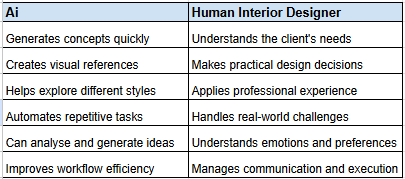
The future is therefore less about Ai versus designers and more about designers using Ai effectively.
Will Ai Replace Entry-Level Interior Designers?
Ai may change some entry-level tasks traditionally performed by junior designers. Basic concept generation, mood-board creation, visual exploration, and certain repetitive activities can increasingly be supported by technology.
This means aspiring designers should not rely only on basic software skills.
Students can prepare for the changing industry by developing:
- Strong design fundamentals
- Practical project experience
- Site-visit experience
- Industry software knowledge
- Ai-assisted design skills
- Presentation abilities
- Client communication skills
- Problem-solving abilities
The goal should be to become a designer who uses technology rather than competes against it.
Why Practical Learning Is More Important in the Ai Era
Ai can generate an image of a beautiful room, but an actual project has physical limitations.
Students need to understand what happens when a concept moves from a screen to a real site. Measurements may change, materials may not be available, budgets may be restricted, and construction conditions can require modifications.
This is why practical learning, site visits, workshops, case studies, and internships remain important for aspiring interior designers.
Technology can support the learning process, but real-world experience helps students understand how interior design works beyond the screen.
How Interior Design Students Can Prepare for an Ai-Driven Future
Students do not need to become Ai specialists. Instead, they should understand how Ai can complement their existing design skills.
A good approach is to:
1. Learn Design Fundamentals First
Understand space planning, proportions, colour, lighting, materials, furniture, and functionality before depending on Ai-generated concepts.
2. Develop Software Skills
Learn the design and visualisation software commonly used in professional interior design workflows.
3. Experiment With Ai Tools
Use Ai for brainstorming, concept development, visual exploration, and presentation support.
4. Build a Strong Portfolio
Showcase your own design thinking rather than simply presenting Ai-generated images.
5. Gain Practical Experience
Participate in site visits, workshops, internships, and real-world projects whenever possible.
6. Strengthen Human Skills
Communication, creativity, critical thinking, empathy, and problem-solving will remain valuable even as technology advances.
Ai-Integrated Learning in Interior Design Education
Interior design education is also evolving with technology. An Ai-integrated learning approach can introduce students to modern workflows while maintaining the importance of fundamental design education.
At Abate Group of Institutions, the best B.Sc. Interior Design College in Malappuram, Calicut, and Kannur, students can develop their interior design knowledge through a combination of industry-focused education, Ai-integrated learning, industry software training, practical projects, international exposure, and placement assistance.
This approach can help students understand not only how to design, but also how emerging technology can be incorporated into modern design workflows.
The Future of Interior Design Careers
Ai is likely to continue influencing the interior design industry. Designers may increasingly use technology for faster concept generation, visualisation, research, documentation, and client presentations.
However, successful designers will still need to bring human judgement to the process.
The future interior designer may not be someone who avoids Ai. Instead, it may be someone who knows when to use Ai, how to use it effectively, and when human expertise should take over.
Conclusion
So, is Ai in interior design a tool, threat, or career advantage?
It can be all three, depending on how it is approached.
For designers who refuse to adapt, Ai may create professional challenges. For those who learn to use it strategically, it can become a powerful tool for improving creativity, efficiency, and productivity.
For students entering the industry, the best approach is not to choose between Ai and human creativity. Develop both.
Learn the fundamentals. Build practical skills. Master design software. Understand Ai. And most importantly, learn how to turn technology into better design solutions.
That combination can help prepare the next generation of interior designers for a rapidly changing industry.