Online vs Offline Interior Design Courses: Which Learning Mode Is Right for You?
 September 12, 2026

Choosing an interior design course is an important decision for students who want to build a career in the creative industry. While the course curriculum and qualification matter, how you learn can also have a major impact on your overall experience.
Today, students can choose between online and offline interior design courses. Online education offers flexibility and convenience, while offline learning provides direct interaction, practical training, and opportunities to experience design in a physical environment.
So, which option is better for learning interior design?
The answer depends on your learning preferences, career goals, schedule, and the type of practical exposure you expect from your course.
What Is an Online Interior Design Course?
An online interior design course is delivered primarily through digital platforms. Students attend classes, access study materials, complete assignments, and communicate with instructors remotely.
Depending on the course, students may learn topics such as:
- Interior design principles
- Space planning
- Colour theory
- Furniture design
- Materials and finishes
- 2D and 3D design
- Design software
- Lighting
- Project planning
Online learning can be useful for students who need flexibility and prefer studying from home.
What Is an Offline Interior Design Course?
An offline interior design course involves attending classes at a physical institution. Students learn directly from faculty members and participate in classroom activities, studio sessions, practical projects, workshops, and other learning experiences.
An offline course may include:
- Classroom learning
- Design studio sessions
- Practical assignments
- Software training
- Workshops
- Site visits
- Material studies
- Group projects
- Industry interactions
- Internships
For a subject like interior design, these activities can help students connect theoretical concepts with real-world applications.
Online vs Offline Interior Design Courses
Both learning modes have their own advantages. Learning the distinctions will help students make an informed choice.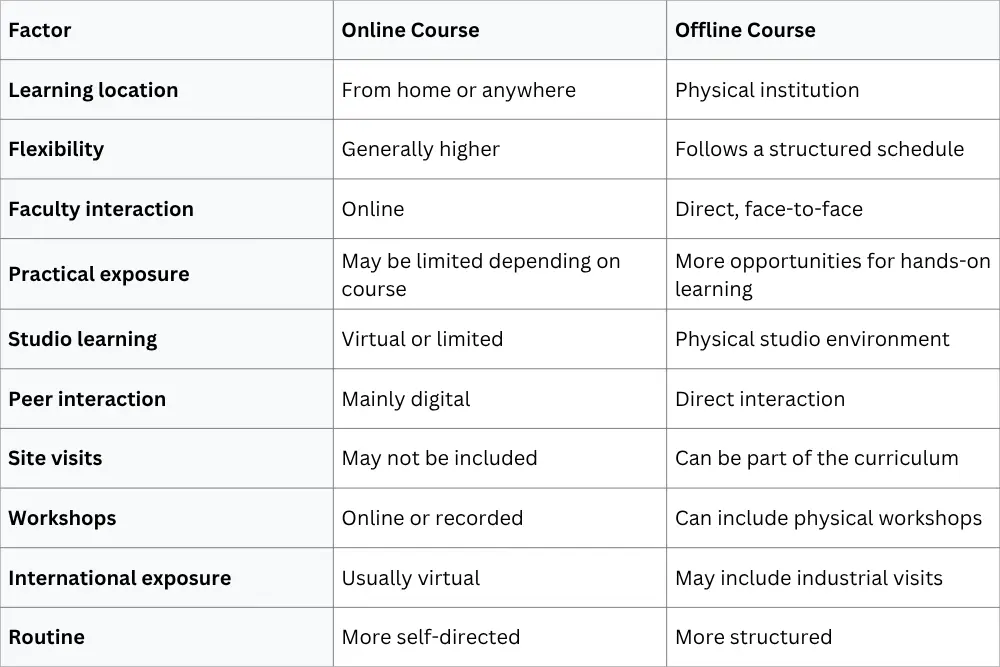
Flexibility of Online Learning
The one major benefit of e-learning is its flexibility.
Students can often attend classes or access learning materials according to their schedules. This can be useful for working professionals, students with other commitments, or learners who cannot regularly travel to an institution.
Online learning can also reduce commuting time and allow students to study from different locations.
However, this flexibility also requires self-discipline. Students need to manage their schedules, complete assignments on time, and remain consistent without the physical structure of a classroom.
The Structure of Offline Learning
Offline courses generally follow a fixed schedule. Students attend classes, studio sessions, workshops, and other activities according to an academic timetable.
This structure can help students develop a regular learning routine.
Direct interaction with faculty can also make it easier to ask questions, receive immediate feedback, and discuss design concepts.
For students who learn better through face-to-face interaction, an offline learning environment can provide a more engaging experience.
Practical Learning in Interior Design
One of the most crucial considerations while opting for an interior design course is the practical exposure that it offers.
Interior design involves much more than understanding design theory. Students need to learn how concepts are developed, presented, modified, and implemented in real spaces.
Offline learning can provide opportunities to participate in:
Design Studio Projects
Students can work on physical and digital design projects while receiving guidance from faculty.
Material Studies
Handling and observing materials can help students understand their texture, finish, appearance, and practical applications.
Site Visits
Visiting real project sites can help students understand measurements, construction, materials, lighting, furniture, and site conditions.
Workshops
Physical workshops can give students opportunities to learn from professionals and gain exposure to practical techniques.
Industry Interaction
Direct interaction with professionals can help students understand workplace expectations and current industry practices.
These experiences can be more difficult to replicate through a fully online course, although some online programmes may provide practical assignments or hybrid experiences.
Learning Interior Design Software
Design software is an important part of modern interior design education.
Students may need to learn software used for:
- 2D drawings
- 3D modelling
- Rendering
- Presentations
- Space planning
- Visualisation
Online courses can teach software effectively through screen-sharing, demonstrations, recorded lessons, and digital assignments.
However, offline learning provides an additional advantage: students can directly ask instructors for help while working on projects and receive immediate feedback.
The quality of software training ultimately depends on the curriculum, instructors, software included, and amount of practical work, rather than simply whether the course is online or offline.
Interaction With Faculty and Other Students
Interior design is a collaborative field. Designers often work with clients, architects, contractors, suppliers, and other professionals.
Offline education allows students to interact directly with faculty and classmates. Group projects and classroom discussions can help students develop communication and teamwork skills.
Online courses can also provide interaction through video calls, discussion forums, messaging platforms, and virtual group projects.
However, the nature of interaction is different in each format.
International Exposure and Industrial Visits
International exposure can introduce students to different design approaches, cultures, materials, architecture, and industry practices.
A physical learning environment can make it easier to organise educational trips and industrial visits.
At Abate Group of Institutions, Interior Design students have opportunities for international industrial exposure, including visits to destinations such as China, Hong Kong, and Singapore.
These experiences allow students to observe different environments and gain broader exposure to design and the built environment.
For students interested in understanding design beyond their local environment, such opportunities can become an important part of their educational experience.
Online vs Offline: Which One Should You Choose?
There is no single answer that applies to every student.
An Online Course May Suit You If:
- You need a flexible schedule.
- You cannot regularly travel to an institution.
- You prefer learning independently.
- You are working while studying.
- You are comfortable using digital learning platforms.
- You are disciplined about completing assignments independently.
An Offline Course May Suit You If:
- You prefer face-to-face learning.
- You want regular faculty guidance.
- You enjoy studio-based learning.
- You want more direct practical exposure.
- You prefer working with classmates on projects.
- You want opportunities for workshops and site visits.
- You value a structured academic routine.
What Should You Check Before Choosing an Interior Design Course?
Instead of choosing a course only because it is online or offline, students should examine the complete learning experience.
Consider these factors:
Curriculum
Check whether the curriculum covers design fundamentals, space planning, materials, lighting, furniture, software, and other relevant subjects.
Practical Training
Find out how much practical work is included in the course.
Software Training
Check which industry-relevant software students will learn and how much hands-on practice is provided.
Faculty
Look at the faculty's academic and professional experience.
Projects
Ask whether students work on practical or industry-oriented projects.
Site Visits and Workshops
Check whether the course provides opportunities to observe real projects and interact with professionals.
Internship Opportunities
Practical work experience can help students understand professional expectations before graduation.
Industry and International Exposure
Look for opportunities that can broaden your understanding of the interior design profession.
Portfolio Development
A strong portfolio can be valuable when applying for internships or jobs. Check whether the course provides opportunities to develop and present projects.
Is Offline Learning Better for Interior Design?
The answer depends on the individual student and the specific institution.
Interior design is a practical and project-oriented field, so students should carefully consider how much hands-on training, studio learning, faculty interaction, site exposure, and industry experience a course provides.
An online course can provide flexibility and access to digital learning, while an offline programme can combine classroom education with physical projects, practical training, workshops, site visits, and direct interaction.
At Abate Group of Institutions, the Interior Design programme in Malappuram, Calicut, and Kannur focuses on an industry-oriented learning experience that combines classroom education, Ai-integrated learning, industry software training, practical projects, international exposure, and placement assistance.
Can You Combine Online and Offline Learning?
Students do not necessarily have to depend on one learning format for everything.
Even students enrolled in offline programmes can use online resources to supplement their education. Tutorials, webinars, digital courses, software demonstrations, and online design communities can help students continue learning outside the classroom.
Similarly, online learners can look for opportunities to gain practical exposure through workshops, internships, site visits, and independent projects.
The most effective approach is often to combine structured education with continuous self-learning and practical experience.
Conclusion
When comparing online vs offline interior design courses, both formats offer different advantages.
Online learning provides flexibility, convenience, and access to digital resources. Offline education can provide structured learning, direct faculty interaction, studio experience, practical training, and opportunities for site visits and industry exposure.
For students planning a long-term career in interior design, the learning format is only one part of the decision. The quality of the curriculum, practical exposure, software training, faculty support, projects, internships, and industry opportunities should also be considered.
Ultimately, choose a course that matches your learning style while giving you the knowledge, practical skills, and industry exposure needed to move from learning interior design to practising it professionally.