BSc Optometry Syllabus: A Complete Curriculum Guide by Abate Institute
 January 22, 2026
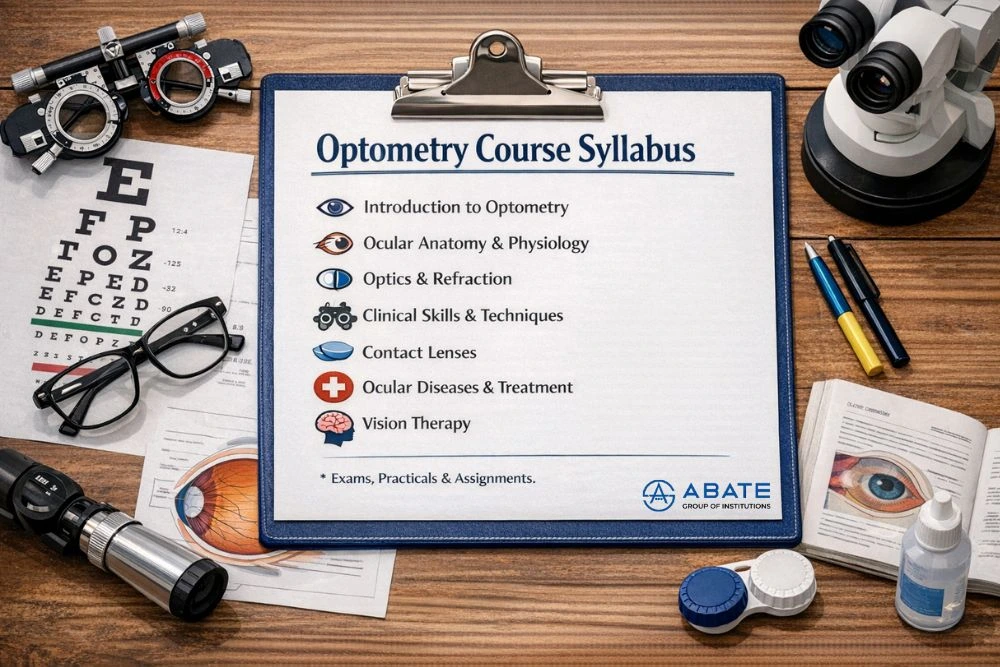
Optometry has become one of the most important allied healthcare professions in modern medical science. With rising vision-related problems, increased screen exposure, and growing awareness of eye health, the demand for qualified optometrists is stronger than ever. A well-structured academic curriculum is essential to prepare students for clinical practice, diagnostic expertise, and emerging fields such as digital and tele-optometry.
The BSc Optometry syllabus offered by the Abate Institute is carefully designed to provide a strong foundation in medical science, visual optics, clinical examination, and patient care. The program blends classroom learning, laboratory training, and extensive clinical exposure to ensure students graduate with professional competence and confidence.
This blog provides a complete overview of the BSc Optometry syllabus at Abate Institute, semester-wise subject structure, and the learning outcomes students can expect from the program.
Why Understanding the BSc Optometry Syllabus Matters
Before choosing an optometry program, students often look for clarity on what they will study throughout the course. A transparent syllabus helps students understand:
- The depth of medical and vision science subjects
- The balance between theory and practical training
- Clinical exposure and internship opportunities
- Career readiness after graduation
The Abate Institute’s BSc Optometry syllabus is structured to gradually build knowledge — starting from basic human anatomy to advanced ocular disease management and clinical internships.
BSc Optometry Syllabus at Abate Institute – Semester-Wise Structure
Semester 1 – Foundation in Medical and Optical Sciences
The first semester builds core understanding of the human body and basic optics, forming the foundation for all future optometry subjects.
Subjects:
- Language I
- English I
- Core I – General Anatomy & Physiology
- Core II – Physical Optics
- Major Practical I
- Allied I – Biochemistry
- Value Education – Environmental Studies
Focus:
Students learn human body structure, physiological functions, and fundamental optical principles essential for understanding how vision works.
Semester 2 – Introduction to Eye Sciences
The second semester shifts focus toward eye-specific anatomy and optical behavior of light.
Subjects:
- Language II
- English II
- Core III – Ocular Anatomy & Physiology
- Core IV – Geometrical Optics
- Major Practical I – Physical & Geometrical Optics
- Allied II – Microbiology
- Value Education – Human Rights
Focus:
Students gain in-depth knowledge of eye structure, light refraction principles, and laboratory-based optical practices.
Semester 3 – Core Optometry and Visual Science
From the third semester, students begin core optometry learning and clinical instrument exposure.
Subjects:
- Core V – Optometric Optics
- Core VI – Visual Optics I
- Core VII – Optometric Instruments & Examination of Visual System
- Major Practical II
- Allied III – Pharmacology
- Value Education – Women’s Rights
Focus:
Students learn vision assessment methods, use of optometric instruments, basics of eye medications, and patient examination techniques.
Semester 4 – Advanced Visual Optics and Examination Skills
The fourth semester strengthens clinical knowledge and professional communication skills.
Subjects:
- Part II – English IV (Employability Skills)
- Core VIII – Visual Optics II
- Core IX – Dispensing Optics
- Core X – Systemic Disease
- Major Practical II – Examination of Visual System
- Allied IV – Pathology
- Value Education – General Awareness
Focus:
Students learn spectacle dispensing, advanced optics, systemic diseases affecting vision, and hands-on examination procedures.
Semester 5 – Specialized Clinical Optometry
Semester five introduces advanced optometry subjects and specialized vision care.
Subjects:
- Core XI – Contact Lens I
- Core XII – Ocular Disease I
- Core XIII – Binocular Vision I
- Core XIV – Low Vision Aid
- Core XV – Occupational Optometry
- Major Practical III
- Elective I (Nutrition / Law & Optometry / Clinical Psychology)
Focus:
Students gain expertise in contact lens practice, ocular disease identification, binocular vision assessment, and vision care for special occupational needs.
Semester 6 – Advanced Eye Care and Community Optometry
The sixth semester expands knowledge into specialized patient care and community-based optometry.
Subjects:
- Core XVI – Contact Lens II
- Core XVII – Ocular Disease II
- Core XVIII – Binocular Vision II
- Core XIX – Geriatric & Pediatric Optometry
- Major Practical III
- Elective II (Community Optometry / Operation Theatre Techniques / Nursing Procedures)
- Project
Focus:
Students learn advanced contact lens practice, management of eye diseases, pediatric and geriatric vision care, and complete a professional project.
Semester 7 & 8 – Compulsory Clinical Internship
The final phase of the program focuses entirely on real-world clinical experience.
Training Component:
- Compulsory Clinical Internship
Focus:
Students work in eye hospitals and clinical settings under professional supervision, performing vision testing, refraction, patient counseling, and assisting in eye care procedures. This internship builds confidence and practical readiness for professional practice.
Teaching and Learning Approach at Abate Institute
The BSc Optometry syllabus at Abate Institute follows a student-centered and practice-oriented learning model:
- Classroom-based theoretical teaching
- Well-equipped optical and clinical laboratories
- Hands-on training with diagnostic instruments
- Hospital-based clinical exposure
- Value education and professional skill development
- Research project experience
This ensures students develop strong academic knowledge along with real clinical competence. At Abate, we provides bsc optometry in Malappuram, Calicut, and Kannur. At our Chennai and Coimbatore branches, we provide the Integrated Optometry Program.
Skills Developed Through the BSc Optometry Program
By completing the syllabus, students gain expertise in:
- Vision testing and refraction
- Eye disease detection and management
- Contact lens practice
- Binocular vision assessment
- Low vision rehabilitation
- Spectacle dispensing
- Patient consultation and counseling
- Clinical instrument handling
- Community and preventive eye care
These skills prepare graduates for diverse roles in eye hospitals, optical clinics, research centers, community vision programs, and digital eye care services.
Career Scope After Completing the Syllabus
After completing the BSc Optometry program, graduates can work as:
- Optometrists in eye hospitals
- Vision care specialists in optical centers
- Contact lens practitioners
- Low vision rehabilitation experts
- Pediatric and geriatric optometry professionals
- Community eye care coordinators
- Tele-optometry and digital vision care consultants
The strong clinical internship component ensures students are job-ready upon graduation.
Why Choose Abate Institute for BSc Optometry
The Abate Institute, one of the best BSc Optometry colleges in Kerala, is committed to delivering quality education in healthcare sciences. With structured academic planning, experienced faculty, modern laboratories, and strong clinical exposure, the institute ensures students receive professional training aligned with current industry standards.
The BSc Optometry syllabus at Abate Institute is designed to match evolving eye care needs, combining academic depth with practical excellence.
Conclusion
A well-designed syllabus is the backbone of professional optometry education. The BSc Optometry syllabus at Abate Institute provides a comprehensive learning journey from fundamental medical sciences to advanced clinical practice and compulsory internships.
For students aspiring to build a career in eye healthcare, this structured curriculum offers the right blend of knowledge, skill development, and real-world exposure needed to succeed as professional optometrists in today’s healthcare environment.